The Ministry of Ecology and Environment will arrange four special law enforcement measures. What issues should enterprises pay attention to?
Release time:2021-05-13 Views:5635
How to make a good start in ecological environment law enforcement in the first year of the 14th Five Year Plan? Cao Liping, Director of the Law Enforcement Bureau of the Ministry of Ecology and Environment, recently stated that based on the positive progress made in ecological environment law enforcement during the 13th Five Year Plan period, this year will place greater emphasis on "precise, scientific, and lawful pollution control", and a total of four special law enforcement actions have been arranged. In the process of special law enforcement, the Ministry of Ecology and Environment will strengthen the linkage with the political and legal departments to severely punish pollution crimes.
It is reported that during the 13th Five Year Plan period, ecological environment law enforcement continued to maintain a high-pressure situation. A total of 833000 environmental administrative penalty cases were implemented nationwide, with a fine amount of 53.61 billion yuan, an increase of 1.4 times and 3.1 times respectively compared to the 12th Five Year Plan period. The number of cases in which the supporting measures for the new environmental protection law have been applied nationwide has reached 147000, effectively deterring environmental illegal and criminal activities.
Cao Liping said that this year's ecological environment law enforcement will focus on prominent issues that affect people's environmental rights and environmental quality, key areas in the battle against pollution prevention and control, and key industries with frequent environmental problems. Organize four special law enforcement actions at the national level.
These four special law enforcement actions are: jointly carrying out a special action on environmental violations of hazardous waste with the Ministry of Public Security and the Supreme People's Procuratorate, focusing on cracking down on illegal discharge, dumping, disposal of hazardous waste and other environmental crimes across administrative regions; Jointly with the Ministry of Public Security and the Supreme People's Procuratorate, a special operation will be launched to crack down on environmental crimes such as tampering with and forging automatic monitoring data; Carry out supervision and assistance for air pollution prevention and control, carry out specialized supervision for industries with prominent problems, and provide motorized assistance for areas with serious problems; Carry out a special operation on nature reserves, known as the "Green Shield" operation.
In this article, the editor will share with you the verification points related to hazardous waste disposal and self-monitoring, for reference by enterprises during self-examination and self correction.
1. Key points related to hazardous waste disposal
The management of hazardous waste includes regulations and policies formulated by national and local administrative departments on hazardous waste issues, as well as policies for implementing these regulations.
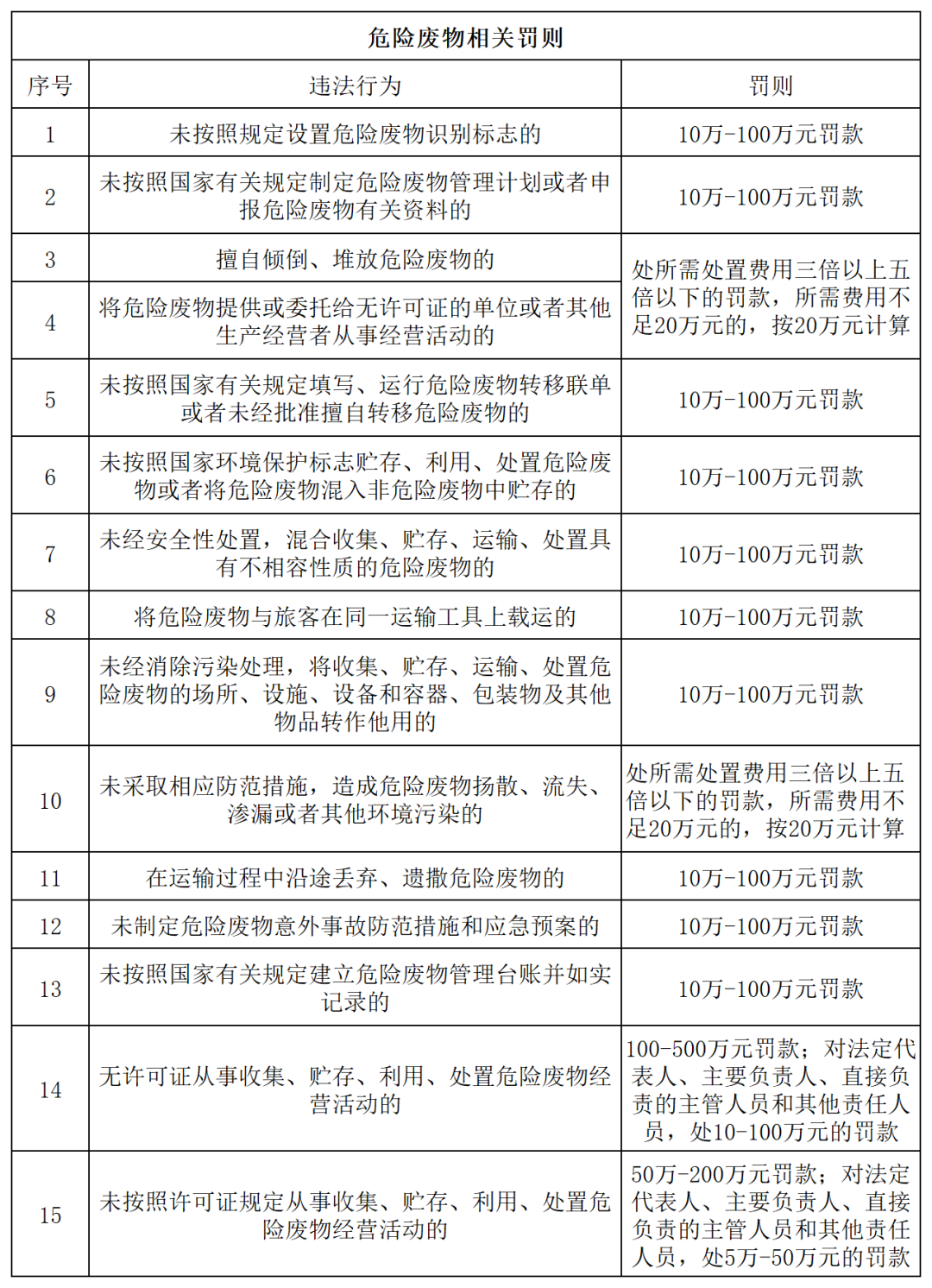
During this process, whether the unit that generates hazardous waste has developed a hazardous waste management plan, whether it stores, utilizes, and disposes of hazardous waste in accordance with national standards, whether hazardous waste is mixed with non hazardous waste for storage, whether a hazardous waste management ledger is established, and whether relevant information such as the type, quantity, flow direction, storage, and disposal of hazardous waste is reported to the local ecological environment department through the national hazardous waste information management system are all of the top priorities for hazardous waste supervision. If the ecological environment management department discovers illegal activities related to hazardous waste, it shall be punished in accordance with Article 112 and Article 114 of the New Solid Waste Law, with a maximum fine of 5 million yuan.
2. Key points for self-monitoring by polluting units
1. Submit a self-monitoring plan to the ecological environment management department, with complete content including schematic diagrams of monitoring points, sampling and sample preservation methods, etc.
2. According to the certification requirements, conduct self-monitoring by oneself or entrust a third party to conduct self-monitoring. The monitoring factors and frequency meet the standards, the monitoring implementation and recording are standardized and complete, and the quality control measures are complete;
Manual monitoring record information includes: manual monitoring date, sampling and measurement methods, monitoring results, etc.
Automatic monitoring and maintenance records include: automatic monitoring and auxiliary equipment operation status, system calibration and verification records, regular comparison monitoring records, maintenance records, fault repair records, inspection dates, etc.
3. Responsible for the authenticity and accuracy of monitoring data, and cannot forge or tamper with data;
4. Timely upload and publicly disclose self-monitoring data;
5. The online monitoring equipment that has been connected to the network (for key polluting units) should report any abnormal situations in a timely manner, while paying attention to the environmental compliance requirements for standardized use, operation and maintenance, and repair.
Regulations on the Administration of Pollutant Discharge Permits:
Article 36: If a pollutant discharging unit violates the provisions of these Regulations and commits any of the following acts, the competent department of ecological environment shall order it to rectify and impose a fine of not less than 20000 yuan but not more than 200000 yuan; Those who refuse to make corrections shall be ordered to suspend production for rectification:
(5) Failure to develop a self-monitoring plan and conduct self-monitoring in accordance with the requirements of the pollutant discharge permit;
(6) Failure to keep original monitoring records in accordance with the requirements of the pollutant discharge permit;
(7) Failure to disclose or inaccurately disclose pollutant discharge information in accordance with the requirements of the pollutant discharge permit;
(8) Failure to report abnormal data transmission from automatic monitoring equipment for pollutant emissions or abnormal situations where pollutant emissions exceed pollutant emission standards;
Amendment XI to the Criminal Law of the People's Republic of China:
Article 229: If personnel of intermediary organizations responsible for asset evaluation, capital verification, validation, accounting, auditing, legal services, sponsorship, safety evaluation, environmental impact assessment, environmental monitoring, etc. intentionally provide false certification documents, and the circumstances are serious, they shall be sentenced to fixed-term imprisonment of not more than five years or criminal detention, and shall also be fined; Anyone who falls under any of the following circumstances shall be sentenced to fixed-term imprisonment of not less than five years but not more than ten years and shall also be fined:
(1) Providing false asset evaluation, accounting, auditing, legal services, sponsorship and other supporting documents related to securities issuance, with particularly serious circumstances;
(2) Providing false asset evaluation, accounting, auditing and other supporting documents related to major asset transactions, with particularly serious circumstances;
(3) Providing false safety assessments, environmental impact assessments, and other supporting documents in major projects involving public safety, resulting in particularly significant losses to public property, national and people's interests.
Those who commit the acts mentioned in the preceding paragraph and also solicit or illegally accept property from others, which constitute a crime, shall be convicted and punished in accordance with the provisions of heavier punishment.
The personnel specified in the first paragraph who are seriously irresponsible and provide certification documents that are significantly untrue, causing serious consequences, shall be sentenced to fixed-term imprisonment of not more than three years or detention, and shall also or only be fined.
Accordingly, if institutions or personnel responsible for environmental monitoring intentionally provide false certification documents, and the circumstances are serious, they may be suspected of crimes such as polluting the environment and damaging computer systems, and their criminal responsibility shall be pursued in accordance with the law.
Disclaimer | Our company maintains neutrality regarding reprints, sharing, statements, and viewpoints, with the sole purpose of communicating with the industry. Copyright belongs to the original author. If there are any copyright or intellectual property infringement issues, please contact our company and delete the content immediately!